
When we talk about sustainability in Norwegian municipalities, it is easy to focus on climate, environment and resource use. But what if we raise our eyes and look at sustainability from a broader perspective? I would argue that sustainability is about more than environmental measures – it is about creating whole communities that work for everyone.
When we talk about sustainability in Norwegian municipalities, it is easy to focus on climate, environment and resource use. But what if we raise our eyes and look at sustainability from a broader perspective? I would argue that sustainability is about far more than environmental measures – it is about creating whole communities that work for everyone.
A story of inspiration
I will never forget the day Jann Engstad from Lofoten received the «Glass Bear» award for Norway’s most environmentally friendly business. He had travelled far to learn more about sustainability in practice. At the same time, I was running Høve Støtt AS, a company focused on guided tours, culture and storytelling. We were early on concerned with our own identity and cultural distinctiveness – something that has always been a central part of our work.
A turning point came when I realised that ecotourism could be a way forward for us. But what does sustainability in tourism actually mean, and why is it so hard to achieve?
Sustainability from a broader perspective
Sustainability is a word that is often understood too narrowly.
In Norway we talk a lot about environment, climate and resource use – but sustainability consists of far more elements. The UN has defined several sustainability principles, and these should guide how municipalities and local communities work:
Cultural identity and richness
Aesthetics in our surroundings
Biodiversity
Environment, climate and resource use
Quality of life and social value creation
Local control and engagement
Job quality
Experience quality and guest satisfaction
A healthy economy in your own business
Value creation in the local community
These principles show that sustainability is about more than taking the bus or cutting emissions. It is also about quality of life, local value creation and taking care of identity and culture.
A more sustainable destination
In 2014, Geilo decided to pursue the certification scheme for sustainable destinations. It was an exciting time, but I remember how we lacked concrete tools to turn the criteria into practice.
I started collecting the questions I was asked about sustainability, and this led to the development of a card deck tool called «Alle kort på bordet» (All cards on the table). The goal was to create openness and dialogue about how we can become more sustainable – not just in tourism, but across the whole municipality.
Sustainable decisions require a holistic view
An important point I want to stress is that sustainability must permeate every part of the municipality – not just tourism. When the municipal council makes decisions, we should ask ourselves:
How does this affect the sustainability of our community?
Does this contribute to better quality of life for residents?
Are we taking care of our cultural and economic resources?
Far too often, the case documents simply say «no environmental consequences». That is not enough. We must dare to see the whole picture and question how our choices affect sustainability in the long run.
A balance between development and preservation
Sustainability is about finding the balance. It is not sustainable to close schools or stop development without considering the consequences for the local community.
At the same time, we must take care of the nature and culture that make our places unique. For example, Geilo today has local food initiatives that spring directly from its sustainability work. This shows how concrete measures can create positive ripple effects.
Sustainability as a shared responsibility
Finally, I want to encourage local politicians, administration and business to work more closely together. Sustainability is not something one sector can solve alone – it requires a holistic approach.
It is about becoming more sustainable – little by little, by making well-considered choices that benefit people, the environment and the local community.
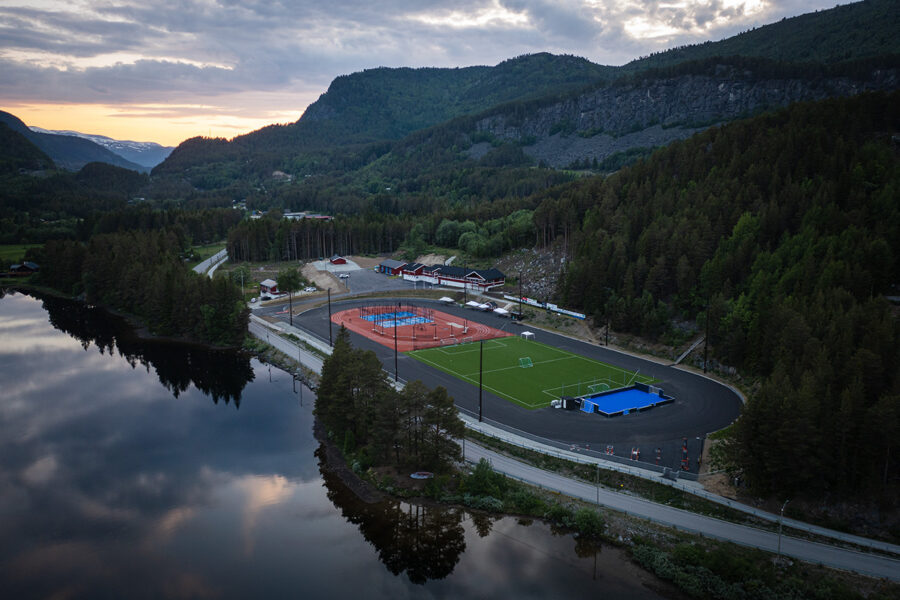
Remember: what is good for the people who live in a place can also be good for those who visit it. As an example, see the picture of the new Hol stadium, below.
Disse prinsippene viser at bærekraft handler om mer enn å kjøre buss eller kutte utslipp. Det handler også om livskvalitet, lokal verdiskaping og å ta vare på identitet og kultur.
Et mer bærekraftig reisemål
I 2014 bestemte Geilo seg for å ta merkeordningen for bærekraftige reisemål. Det var en spennende tid, men jeg husker hvordan vi manglet konkrete verktøy for å omsette kriteriene til praksis.
Jeg begynte å samle spørsmål jeg fikk rundt bærekraft, og dette førte til utviklingen av et kortstokk-verktøy kalt “Alle kort på bordet”. Målet var å skape åpenhet og dialog om hvordan vi kan bli mer bærekraftige – ikke bare i reiselivet, men i hele kommunen.
Bærekraftige vedtak krever helhet
Et viktig poeng jeg vil understreke er at bærekraft må gjennomsyre alle deler av kommunen – ikke bare reiselivet. Når kommunestyret gjør vedtak, burde vi spørre oss:
- Hvordan påvirker dette bærekraften i samfunnet?
- Bidrar dette til bedre livskvalitet for innbyggerne?
- Ivaretar vi våre kulturelle og økonomiske ressurser?
Altfor ofte står det “ingen miljøkonsekvenser” i sakspapirene. Det er ikke nok. Vi må våge å se helheten og stille spørsmål ved hvordan våre valg påvirker bærekraften på lang sikt.
En balanse mellom utvikling og vern
Bærekraft handler om å finne balansen. Det er ikke bærekraftig å legge ned skoler eller stoppe utvikling uten å tenke på konsekvensene for lokalsamfunnet.
Samtidig må vi ta vare på naturen og kulturen som gjør våre steder unike. For eksempel har Geilo i dag lokalmattiltak som springer ut fra bærekraftsarbeidet. Dette viser hvordan konkrete tiltak kan skape positive ringvirkninger.
Bærekraft som felles ansvar
Til slutt vil jeg oppfordre kommunepolitikere, administrasjon og næringsliv til å samarbeide tettere. Bærekraft er ikke noe én sektor kan løse alene – det krever en helhetlig tilnærming.
Det handler om å bli mer bærekraftig – litt etter litt, ved å gjøre gjennomtenkte valg som gagner både mennesker, miljø og lokalsamfunn.
Husk: Det som er godt for de som bor et sted, kan også være godt for de som besøker det samme stedet. Til eksempel, se bilde av nye Hol stadion, under.
Watch the film this article is based on, below* We at Hallingcast have worked with the card deck in several settings. The author of this article, who created the deck, once inspired us to shine 10 equally strong lights on a very large and complex topic: sustainability. That in turn inspired us to create sustainability principles for Kantefølflak, and to turn the film below into a SPENST article on Hallingcast.no. We sincerely believe more businesses should put the tool to use. You will find the card deck at Torpomoen, among other places, surrounded by 17 coloured lights on a white table. * The film was made as a contribution to the digital conference “Vertskommunen: Korleis bygge framtidas reisemål?”, November 2024.